


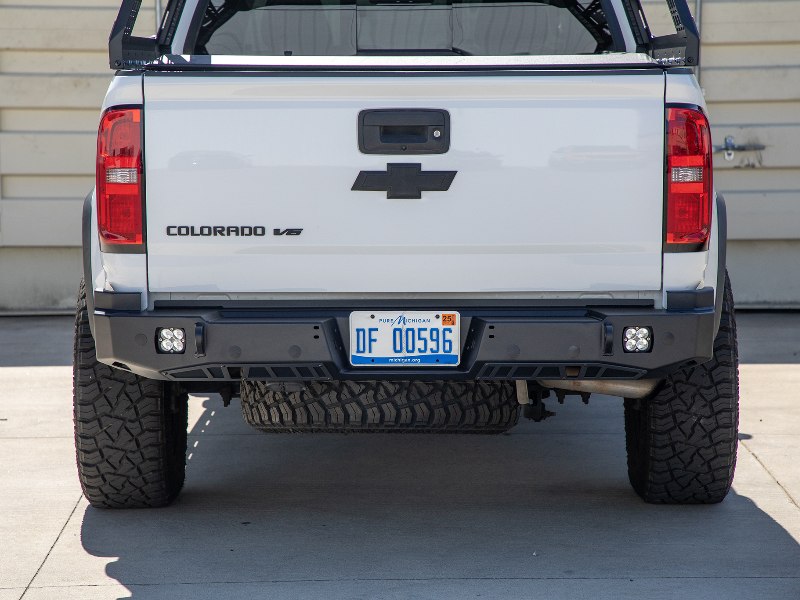
The material you choose decides almost everything about a rear bumper: how much abuse it absorbs, how much it adds to the rear axle, how it ages in road salt, whether a shop can repair it, and what it costs. Steel, aluminum, chrome-plated steel, and composite materials each have their own advantages. In this guide, we compare them in the way a fabricator would—based on their performance, not on marketing claims. Understanding the best materials for heavy-duty truck rear bumpers is essential for making an informed choice.
Carbon Steel: The Default for Heavy-Duty Use
Most real heavy-duty rear bumpers are made of mild carbon steel, which is usually A36 plate or comparable sheet in 12-gauge through 1/4 inch. Steel is the default because of one property combination that other materials cannot match at the price: high yield strength, high ductility, and easy weld repair.
Why Ductility Matters More Than Hardness for Heavy-Duty Truck Rear Bumpers
When considering options, it’s crucial to evaluate the materials for heavy-duty truck rear bumpers that can withstand extreme conditions and provide durability and reliability.
A bumper’s job is to absorb energy, not to prevent scratches. Mild steel deforms gradually under impact and maintains load during this process. But harder, more brittle materials may break instead. That is why a steel bumper hit by a trailer usually bends and can be pulled straight, while a cracked casting can just be scrapped.
Typical Gauges and What They Are For
- 16-18 gauge (1.2-1.5 mm): factory stamped bumpers – light and cosmetic, enough for parking impacts
- 12-14 gauge (2.0-2.7 mm): heavy-duty replacement shells – more rigid, still bolt-on weight
- 3/16 in. (4.8 mm): mounting brackets and wing plates for professional off-road bumpers
- 1/4 in. (6.4 mm): shackle mount plates and frame-tie brackets for vehicles with winches
The Weakness: Corrosion
Bare steel will rust, but a rear bumper lives in wheel spray. This is why finish quality is as important as gauge. E-coat followed by powder coat is the most effective and common protection, while applying a single wet-paint layer over untreated steel is the weakest. In all, you had better choose a bumper with coatings both inside and outside, because most factory bumpers rust from the inside out.
Aluminum: Light, Corrosion-Resistant, Expensive
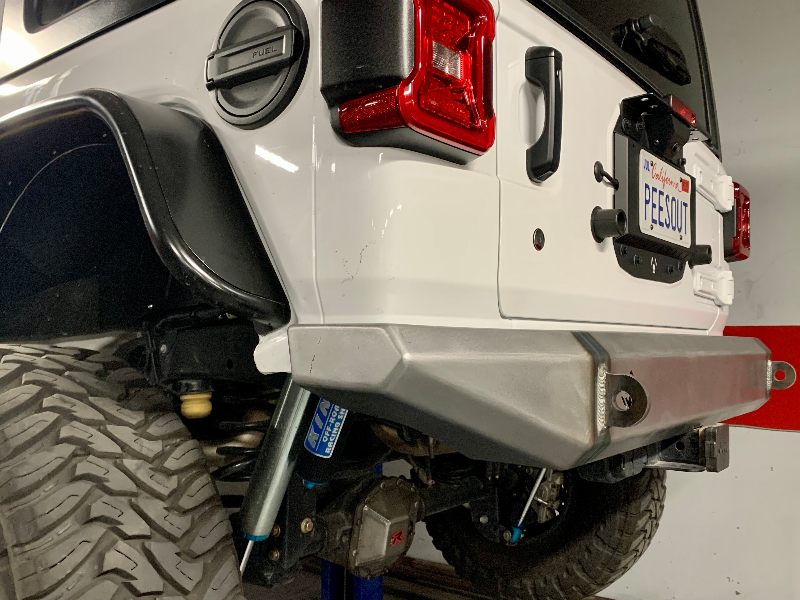
Aluminum alloys used for bumpers – usually 5052 or 6061 – weigh about one-third of steel for the same volume. A typical aluminum plate rear bumper is 40 to 80 pounds lighter than a steel rear bumper of the same size. It is really important for payload-limited trucks and vehicles that are already equipped with rooftop tents, drawer systems, and full water tanks.
Aluminum also does not rust. It forms a self-limiting oxide layer instead, so scratches on aluminum bumpers only result in a dull appearance and will not affect the structure. This is a significant advantage in coastal and heavy-salt regions.
However, there are also some disadvantages. Aluminum has a lower elastic modulus, so a thicker material is needed for the same stiffness, which claws back part of the weight savings. It work-hardens and is more prone to fatigue cracking at welds under repeated load. If you want to repair it, you should go to a shop with AC TIG capability and the right filler. Therefore, it is more difficult and expensive than repairing mild steel. The cost of raw materials and processing usually makes aluminum bumpers 40% to 100% more expensive than comparable steels. We introduce the numbers in detail in the steel vs aluminum rear bumper price comparison.
Galvanic Corrosion Warning
If bare aluminum is directly bolted to a steel frame by road salt, a galvanic cell will be formed, and the aluminum corrodes first at the contact points. Any properly engineered aluminum bumper uses isolating washers, coatings, or stainless hardware. If isolation is not mentioned in a listing, you can ask the seller.
Chrome-Plated Steel: Looks First
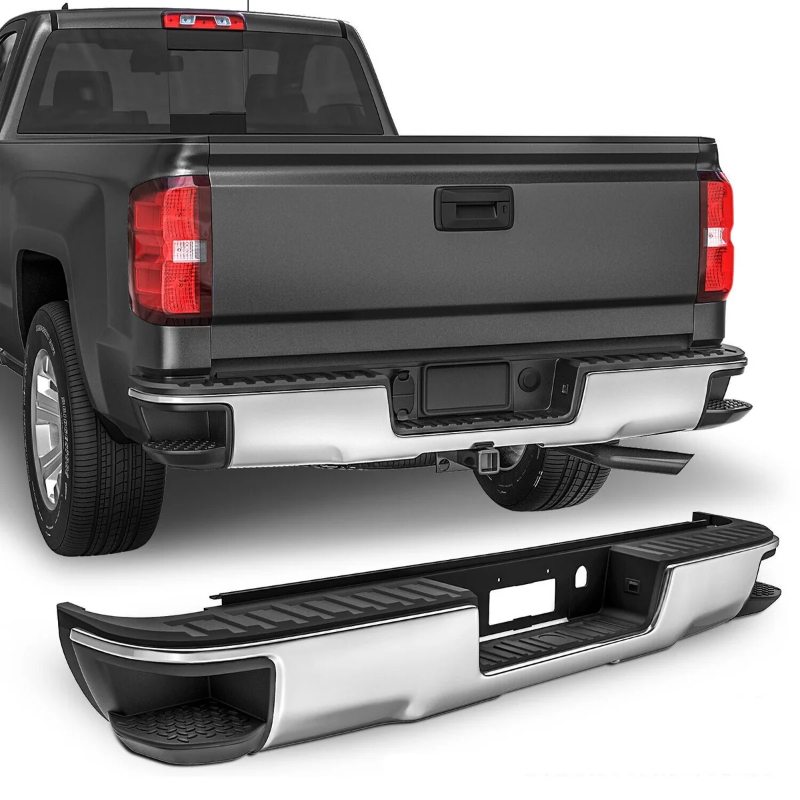
Chrome bumpers use steel as the base material with a decorative nickel-chrome plating. Its structural properties are the same as the underlying steel, but the plating is thinner, harder, and slightly more porous. Once the chrome is scratched by a stone or a hitch, moisture will get into the steel and rust will spread outward from that point. Chrome is ideal for a clean-cut display or restoration truck, but not for a work or trail truck.
Composite and Plastic Bumpers
Many new trucks have a molded plastic cover over a steel or aluminum reinforcement beam and energy-absorbing foam. The system is designed with pedestrian safety and low-speed crash performance at its core, and it works well for those goals. However, it cannot withstand point loads. A plastic-faced bumper will crack after contact with a rock or a trailer tongue. Moreover, it cannot be repaired in any meaningful way
Some replacement bumpers feature a steel outer layer wrapped in black plastic trim. In fact, it is a good choice for owners who want to restore the OEM appearance on a work truck without paying for a body-shop colour match.
Stainless Steel and Exotics
304 stainless can resist corrosion better than mild steel and is sometimes used for step surfaces and trim. Full stainless bumpers are rare. This material costs several times more than mild steel. Also, it is harder to form and more difficult to repair in the field. Titanium alloys and carbon fibre are commonly used in racing but not in any practical truck bumpers.
Material Comparison at a Glance
- Impact strength and repairability: carbon steel wins
- Weight: aluminum wins a lot compared with other materials
- Corrosion resistance: aluminum is the best, then coated steel, then chrome, then bare steel
- Cost per unit of strength: carbon steel wins
- Appearance on a clean truck: chrome and painted composite
- Best all-round for a work truck: powder-coated heavy-gauge carbon steel
Which Should You Buy?
If your truck tows, carries loads, sees dirt roads, or simply needs a rusted-out bumper replacement, powder-coated heavy-gauge carbon steel is the correct choice for most truck owners. Also, it is the most cost-effective option because it can be repaired anywhere. What’s more, modern coatings have largely solved the corrosion problem that gave steel its reputation.
You should choose aluminum only if your long-haul off-road vehicle has a truly limited payload and you can accept the cost and repair limitations. But you can choose chrome only for appearance. It’s also necessary to avoid using plastic-faced bumpers on any truck that leaves pavement.
You can learn how material choice performs in real trail conditions in our guide to the best heavy-duty rear bumpers for off-road use. Or you can also find direct-fit heavy-duty steel rear bumpers for Ford, Chevrolet, GMC, Toyota, and Nissan trucks.
