


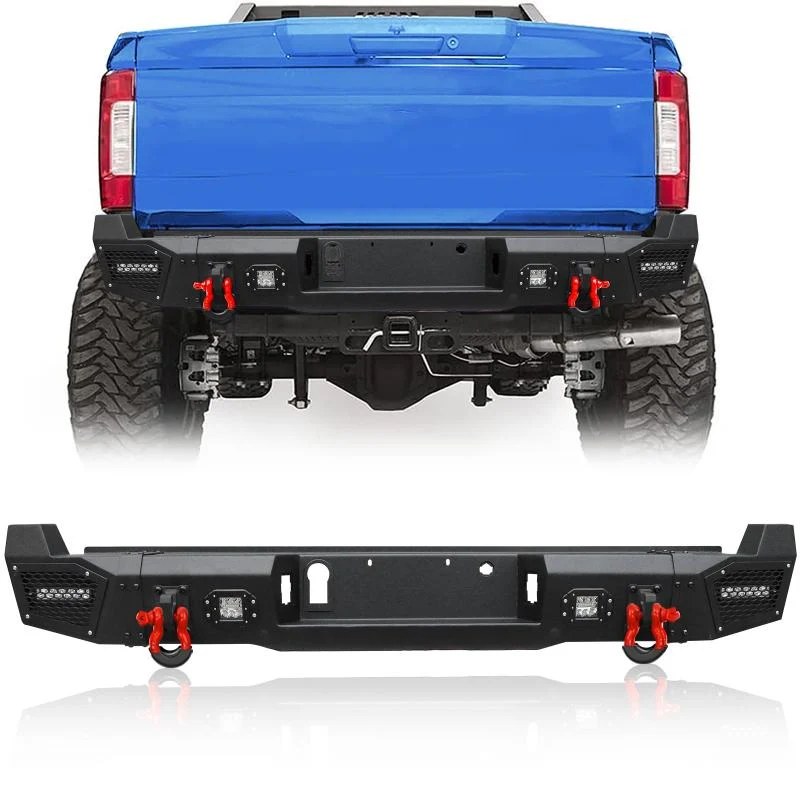
The rear bumper is the part of a truck that most easily comes into contact with the road surface. Whether you want to reverse off a rutted approach or a rock shelf, or get winched out of a mud hole, the load will be concentrated on the weakest part of the original bumper. The rear bumpers of most stock light trucks are made of thin stamped steel over a plastic step pad. They are mainly designed to look good and pass a low-speed parking-lot impact rather than carrying rescue goods or surviving a tree stump. Upgrading to Heavy-Duty Truck Rear Bumpers is essential for those who demand durability.
If you often use your truck off pavement, it is one of the most worthwhile modifications you can make to upgrade to a truly heavy-duty rear bumper. In this guide, we introduce the differences between a real off-road bumper and a decorative one. Moreover, you can learn which heavy-duty truck rear bumpers are suitable for the most common American trucks, including options for Heavy-Duty Truck Rear Bumpers that enhance performance.
Understanding Heavy-Duty Truck Rear Bumpers
Marketing language is cheap. When you strip it away, four measurable factors actually decide whether a rear bumper will hold up on the trail.
Steel Gauge and Plate Thickness
In fact, factory rear bumpers on most half-ton pickups use about 16- to 18-gauge steel (about 1.2 to 1.5 mm). A heavy-duty replacement usually uses 12-gauge or thicker in the shell, while the mounting brackets and wing ends use 3/16-inch or 1/4-inch thick steel plates. That extra material is not for weight reduction; instead, it can help prevent the bumper from folding when it gets stuck in a corner by a stone.
Thickness is most important in areas where loads concentrate, such as the frame mounts, the hitch area, and the outer corners. A bumper made of thick steel plates everywhere is heavy and expensive, while a well-designed one puts the material where the stress is. If you want to know more about gauges, alloys, and coatings, please refer to our guide to the best materials for a heavy-duty rear bumper.
Departure Angle and Corner Clearance
Departure angle is the maximum slope where your truck can back down without dragging the rear bumper. Every inch of bumper below and behind the rear axle will lose angle. Usually, Off-road-oriented bumpers have higher corners and are closer to the body. Therefore, a good trail bumper often looks smaller than the factory one even though it is heavier. For a pickup truck with factory height, a well-installed rear bumper can increase the departure angle by 3 to 6 degrees. It determines whether the vehicle can go over a curb or get stuck.
Real Recovery Points
A tow ball is not a recovery point, and a bumper bolted to sheet metal. Real recovery points are directly fixed to the vehicle frame or bumper brackets with bolts or solder. The bumper bracket itself is bolted to the frame rails at factory locations. If it is advertised that a bumper has D-ring or shackle mounts, you’d better check the plate thickness behind them and how they connect to the mounting brackets. When you are in doubt, please recover from a Class III/IV receiver hitch with a rated shackle mount rather than from the bumper skin.
Fitment and Mounting
In fact, a direct bolt-on bumper that uses the factory mounting holes is always stronger in practice than a universal bumper that is hung on adapter brackets. This is because the load path stays where the engineers put it. Bolt-on design also means you can install it yourself in an afternoon with hand tools. Moreover, you can remove it just as easily if you want to sell the truck.
Bolt-On Heavy-Duty vs. Full Aftermarket Plate Bumpers
Bumpers are generally divided into two categories. And you can save a lot if you choose the right one.
Heavy-gauge OEM-style replacements keep the factory shape and mounting points. Also, they are pre-drilled at the factory for sensors and license plate lights. They are usually sold between $250 and $450. They can still restore full strength and a clean look after rust or collision damage. What’s more, they can handle trail use, towing, and work-site abuse without any problems. For most drivers who enjoy off-roading on weekends but drive trucks daily, this is the correct choice.
Full plate off-road bumpers add integrated shackle mounts, tire carriers, high-clearance cuts, and light provisions. They are sold from $900 to $2,500. Also, they add 100 to 200 lb. Therefore, people should often relocate the sensor, or it can result in insurance and inspection issues. However, they are worth it if you often drive on technical trails or overland with a swing-out spare.
Best Heavy-Duty Rear Bumper Picks by Truck Platform
Toyota Tundra (2000-2013)
First-generation Tundras are still popular trail trucks, but their rear bumpers usually rust from the inside out. A heavy-gauge steel replacement such as the 1st Gen Tundra Rear Bumper (2000-2006) can restore the factory step and mounting points. But the price is only a fraction of a full-size bumper. For 2007-2013 trucks, a matching second-generation replacement can fit perfectly; while for 2014-2021 model year trucks, people only need to fix damaged corners to replace the end caps instead of the whole component.
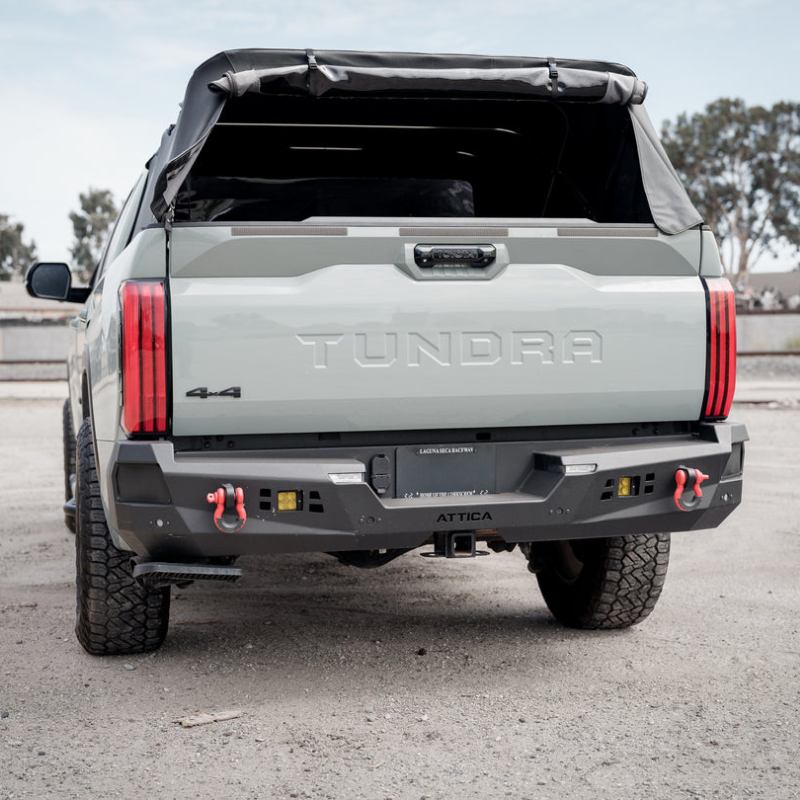
Chevrolet Silverado and GMC Sierra
Silverado and Sierra rear bumpers should withstand a beating from trailer tongues and salt. You can all find suitable replacement units for the 1988-2000, 1999-2007, 2007-2013, 2011-2014, 2015-2019, and 2019-2023 generations, which cover nearly every GM half-ton on the market today. If your vehicle is equipped with corner step pads and park-assist sensors, you should look for a unit whose installation position has been pre-cut.
Ford F-250 and F-350
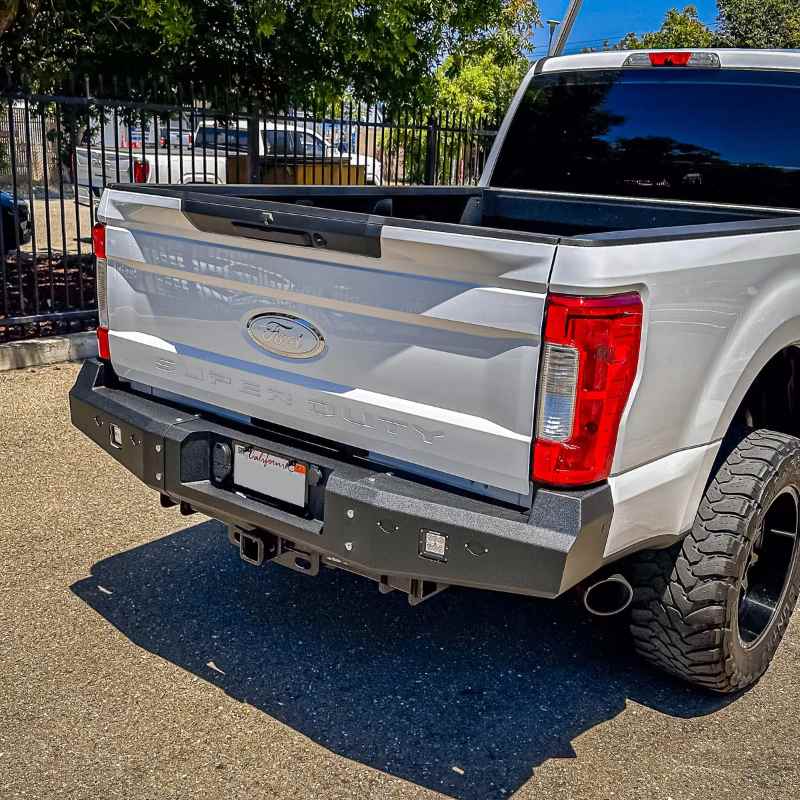
Super Duty trucks usually carry more weight and have stronger traction, so the rear bumper bears greater impact loads. For both the 1999-2007 and 2008-2016 models, there are direct-fit heavy steel replacements. The newer models are available in two versions: one with a sensor port and one without. You can avoid a return if you choose the correct variant for the first time.
Nissan Titan and Ford Ranger
There are limited off-road bumper selections for mid-size and less common vehicles. Actually, you can find direct-fit steel rear bumpers for the 2004-2015 Titan and the 1993-2011 Ranger. Since these trucks are lighter, the bolt-on steel unit has an advantage in terms of strength and weight.
Features Worth Paying Extra Money
- Powder-coated or e-coated finish rather than paint – Off-road wear will expose bare steel, and coating quality decides whether it rusts in one winter or five
- Pre-drilled sensor and license-plate light holes perfectly match your exact trim
- Integrated step pads with a real anti-slip surface, not a smooth stamped panel
- Class III or higher receiver compatibility so that towing capacity will not be affected
- US warehouse stock, so a damaged bumper does not leave the truck parked for six weeks
Mistakes to Avoid When Buying
There are three main reasons for most returns. The first is that people just order by model year. Mid-cycle refreshes will change bumper mounting and sensor layout, so you must confirm it by year range and trim. The second is ignoring sensor holes. People cannot install the park assist system on a bumper without them. Instead, if your truck doesn’t have a park assist system, then a bumper with sensor holes will look unfinished. The third is assuming heavier is always better. In fact, if you install a 200 lb bumper on a fully loaded half-ton truck, it may change rear ride height, headlight beam angle, and payload margin.
Final Recommendation
In conclusion, for most truck owners, the best off-road rear bumper is a heavy-gauge, direct bolt-on steel replacement. It can fit the vehicle perfectly, and there is real material added where impacts happen. Moreover, the price is only a few hundred dollars rather than a few thousand. Please leave the full plate bumper for trucks that really need a tire carrier and integrated shackles.
You can easily find direct-fit steel options for Toyota, Chevrolet, GMC, Ford, and Nissan trucks in the heavy-duty truck rear bumpers collection. The products will be shipped from the US warehouse within 3-5 business days.
