


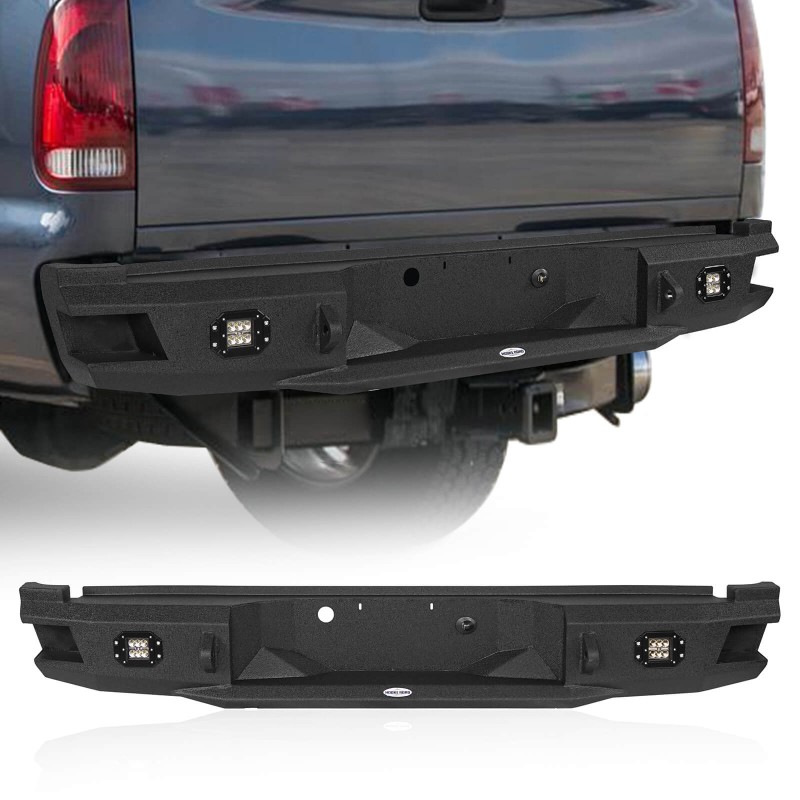
There are three main reasons to replace rear bumpers, including the need for a Replacement Rear Bumper. First, rust has eaten through the shell. Second, the bumper was bent due to a parking-lot or trailer impact. Third, the owner wants stronger parts than the factory ones. Whatever the reason is, the selection process is the same. And if you want to make the right choice for the first time, you need to check five things in order. Here are five things to do in the correct order to effectively avoid returns.
Understanding the Importance of a Replacement Rear Bumper
Confirm Exact Fitment, Not Just Model
The installation position of the bumpers may change with body generations and mid-cycle refreshes, but manufacturers rarely announce it. For example, although the 2013 and 2015 Silverado models are both called Silverado 1500, their rear bumpers are different.
Before ordering, you need to write down four things at first: model year, generation, cab and bed configuration, and trim level. After that, you can match by the year range in the product title rather than assuming. These years are divided into very detailed ranges, for example: Toyota Tundra splits at 2000-2006, 2007-2013 and 2014-2021; Ford Super Duty splits at 1999-2007 and 2008-2016; Chevrolet and GMC split at 1988-2000, 1999-2007, 2007-2013, 2011-2014, 2015-2019 and 2019-2023.
But for platforms with a long single run, such as the 2004-2015 Nissan Titan Rear Bumper, installation is simpler. However, it is still necessary to verify based on the production year after VIN decoding rather than the registration year, because the two may differ.
Match the Sensor and Accessory Configuration
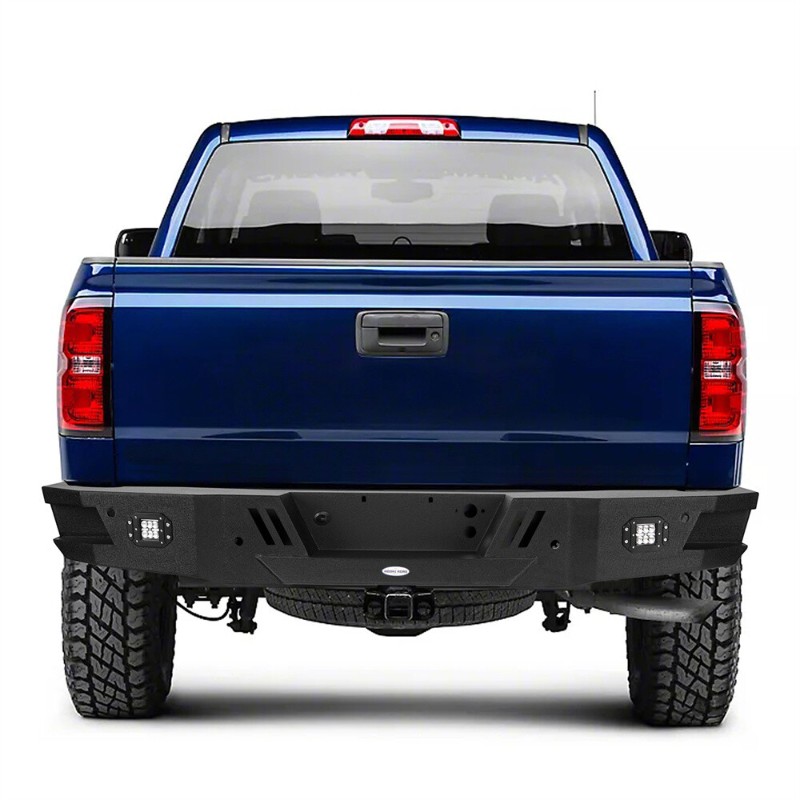
This is the most common ordering mistake for trucks from about 2008 onward. Models with parking assist have pre-drilled holes for sensors, while base trims do not. However, some bumpers are sold in both variants, and you must select the right one.
- Park assist / object sensors – you can count the round sensor faces on your current bumper
- Corner step cutouts on trucks suitable for them
- License plate light location and connector type
- Bumper-mounted trailer connector aperture
- Backup camera housing, if the camera is in the bumper rather than the tailgate handle
Before ordering, please take photos of the front of your existing bumper and each corner. It takes just two minutes, and you can solve almost every fitment problem.
Choose the Material and Gauge
For a truck that works normally, you can use heavy-gauge carbon steel with a powder-coated or e-coated finish. It offers the best value for money and can be repaired anywhere. Moreover, modern coatings are well-suited to resist salt corrosion. Aluminum parts are lightweight, but much more expensive and more difficult to repair. Chrome looks excellent, but it chips easily. Plastic-faced units can restore OEM appearance at a lower cost, but they cannot withstand point loads.
We compare the best materials for heavy-duty rear bumpers, including gauges, coatings, and corrosion behaviour in detail.
Check Hitch and Towing Compatibility
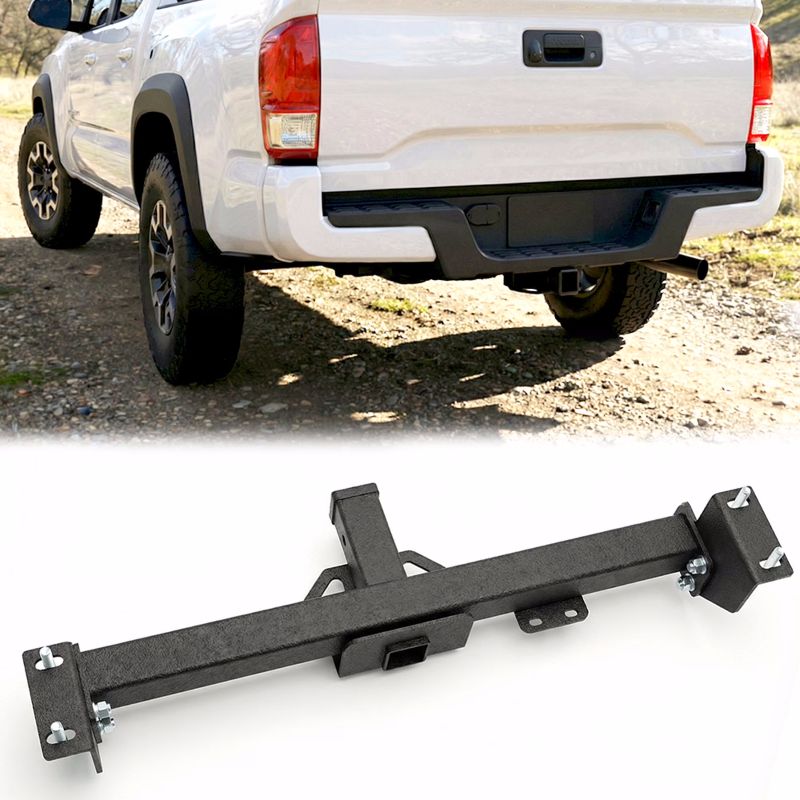
If you want to tow, you should confirm two separate things. First, you need to check whether the bumper itself has dragging capability. Many stamped bumpers have a hole for a ball, but the surface is printed with a low tongue-weight limit. Second, you should consider whether the bumper will interfere with an existing receiver hitch and any weight-distribution hardware. Most trucks’ traction is handled by a Class III or Class IV receiver mounted on the frame. So the bumper only needs to avoid it, not carry the load.
What’s more, it is necessary to verify that the bumper will not block your trailer connector or reduce contact with the receiver pin with a wiring bracket.
Assess Installation Requirements
In fact, you just need to secure it directly to the factory mounting points with bolts. There is no need for drilling, cutting, or welding. Only hand tools are needed, and the original state can be restored later. However, universal bumpers that require adapter brackets will change the load path and are more likely to sit misaligned. If the product description does not clearly state that the factory mounting points are used, you can just treat it as a custom fit.
What to Expect on Price
- OEM-style steel replacement: about $250-$450 for different platforms and sizes
- Super Duty and heavy 3/4-ton units: due to their larger size and greater steel usage, they are more expensive
- Corner end caps only: $120-$180; it is a good choice if only the corners are damaged
- Aftermarket plate off-road bumper: $900-$2,500
- Custom fabricated one-off: $1,500-$3,500, plus delivery time
- Dealer OEM part: often $600-$1,200, excluding painting and labour
Moreover, you need to weigh shipping and delivery time. Bumpers are bulky items. If a supplier has stock in its US warehouse, they can ship within 3-5 days. Compared with ordering and shipping from overseas, this saves money and reduces truck downtime.
Questions Worth Asking Before You Buy
- Can this be fixed with bolts directly to the original factory mounting points?
- Which sensor variant is this, and can I change my selection?
- What gauge steel is the shell, and how is it coated inside as well as outside?
- Is the mounting hardware included?
- Where does it ship from, and what is the return policy if the size is not right?
Summary
If you do five things, your bumper will fit like an original part and be even more durable. First, you should ensure nail fitment by year range and trim. Second, you need to match the sensor configuration. Third, you’d better choose coated heavy-gauge steel unless there are special reasons. Fourth, please confirm hitch clearance. Finally, you need to insist on direct bolt-on mounting.
You can find all direct-fit replacement truck rear bumpers for Toyota, Ford, Chevrolet, GMC, and Nissan pickups. They will normally be shipped from a US warehouse in 3-5 business days.
Frequently Asked Questions
Do I have to replace the whole bumper if only a corner is damaged?
Not always. Some models, including the 2014-2021 Toyota Tundra, have separate left and right end caps that can be replaced individually. It costs far less than replacing the full assembly. You should check the centre section and mounting brackets first. If they are straight and not rusty, you may just need to replace the caps.
Is an aftermarket replacement as strong as the OEM part?
A heavy-gauge steel replacement using factory mounting points is usually thicker than the stamped original one, so it is stronger in most cases. The important factors are gauge, bracket plate thickness, and coating, not whether there is a manufacturer logo on the part.
Will a new rear bumper affect my park assist calibration?
You don’t need to recalibrate after transferring the original sensors into a correctly matched sensor-hole bumper, because the sensor position and angle are reproduced. However, something may go wrong if sensors are installed in cutouts at a different height or angle than the factory location.
Should I buy painted, powder-coated, or raw?
For trucks that are parked outdoors year-round, powder-coated or e-coated is the most cost-effective option. Bumpers without primer or base coat need immediate finishing work. Otherwise, you may find visible surface rust within a season in any salt or coastal environment.
